Recurring running setbacks are easy to blame on mileage, bad luck, or one hard workout. But when the same problems keep showing up, such as fading form late in long runs, one side of the body feeling different from the other, or momentum disappearing at the same point in every training block etc., the pattern is usually worth examining more carefully.
At Vision Quest Coaching in Highland Park, we use Kinotek 3D movement screening to look at exactly how your body moves across key functional patterns. It is one of the most specific and actionable starting points we offer runners, and it consistently reveals things that training logs, pace data, and even strength assessments cannot show on their own.
What Kinotek Movement Screening Actually Shows
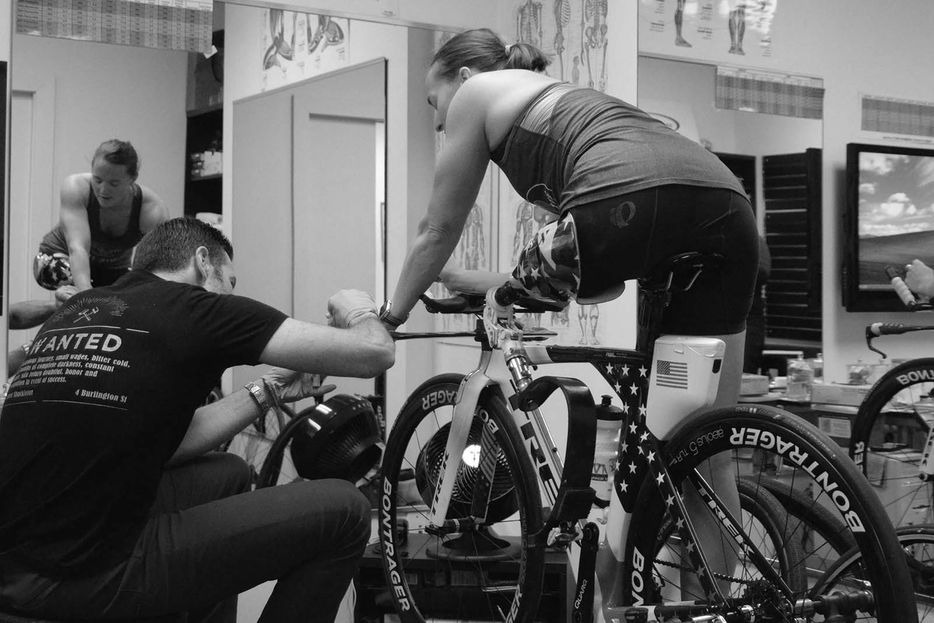
Kinotek uses advanced 3D motion-capture technology, the same type used in clinical and professional sports settings, to map how your body moves through key functional patterns. It produces a scored, visual report in minutes. The results are not a subjective opinion from a coach watching you move. They are measurable data points your coach can act on immediately.
For runners specifically, a Kinotek screen commonly identifies left-to-right asymmetries in strength and control that compound over thousands of running strides, hip mobility restrictions that affect stride length and glute engagement, knee tracking patterns that put stress on structures not designed to absorb that load, and core stability gaps that cause form to break down when fatigue builds in the final miles of a long run or race.
None of these findings diagnose an injury or predict one with certainty. What they do is give your coach a specific, prioritized list of what to address in your strength program, rather than guessing based on general principles or adding exercises because they are commonly recommended for runners.
Movement Screening in Highland Park: How It Fits Your Training Plan
A Kinotek screen is not a standalone test. At Vision Quest, the findings are reviewed with your coach immediately after the assessment and connected directly to your current training load, race timeline, and schedule availability.
That context matters. A runner with 10 weeks until the Chicago Marathon and a hip asymmetry showing on the Kinotek screen needs a different response than a runner in the middle of a base-building phase with six months before their next race. The screen gives us the information. Your coach determines what it means for your specific situation right now.
For runners who also ride or compete in triathlon, the Kinotek findings inform the full training picture. An asymmetry that shows up in running often shows up on the bike too, and addressing it in your strength program benefits both sports simultaneously. Our triathlon coaching team builds these connections into your plan rather than treating each sport as a separate program.
Strength Evaluations in Highland Park: Turning Screen Results Into Priorities
The Kinotek screen shows us where compensation patterns exist. A strength evaluation shows us how much capacity is behind those patterns or missing from them.
Together, they give your coach a complete picture of your movement quality and the strength required to sustain it under training load. For runners, the most relevant qualities include single-leg control and stability, posterior chain strength in the glutes and hamstrings that drives propulsion and protects the lower back, hip and ankle mobility that allows full stride range without compensation, and core control under dynamic conditions and not just planks, but the ability to resist unwanted movement while running at pace.
Busy schedules deserve a focused approach. A runner with limited time does not need a long list of exercises competing with key training sessions for energy and recovery. We use the screen and evaluation findings to identify the two or three priorities that will produce the most meaningful improvement for your current training block. That is a very different outcome from a generic running strength program.
How Other Testing Connects to Your Movement Screen Results
Kinotek tells us how you move. Other performance testing at Vision Quest answers different questions and when combined, they give your coach a complete physiological picture rather than a series of disconnected data points.
A DEXA body composition scan shows your lean mass distribution by region. When a Kinotek screen reveals a significant left-to-right asymmetry in the legs, the DEXA data tells us whether there is a corresponding difference in lean mass between the two sides — which helps determine whether the issue is primarily a strength gap, a movement pattern, or both.
VO₂ max testing measures your aerobic capacity and establishes the training zones that should govern every run in your program. RMR testing measures how many calories your body burns at rest, which is the foundation of any fueling strategy. Many runners are chronically underfueling relative to their training demands — and that underfueling shows up in recovery quality, which directly affects how well movement patterns hold up under fatigue.
Robbie’s metabolic assessment at Vision Quest — which can be performed on a treadmill for runners or on a bike for cyclists — provides a complete metabolic profile including your aerobic threshold, anaerobic threshold, fat and carbohydrate combustion rates at every intensity, and how lactate accumulates and clears. For runners, this test answers the specific question of which energy systems are limiting your performance and how your training should be structured around them. It is a distinct test from VO₂ max testing, and the two answer different questions.
Sweat and sodium testing fits naturally alongside the movement screen for any training block. Understanding your personal fluid loss rate and sodium concentration gives you a personalized hydration plan for training and racing rather than one based on general guidelines. For Midwest runners where temperature and humidity vary significantly across the training year, this data removes one more variable from race-day decision-making.
Who This Is Not For
If you are dealing with acute pain or a specific injury, a Kinotek movement screen is not the right first step. VQ is not a medical provider, and the screen is not a diagnostic tool for injury. If something hurts, see a physical therapist or sports medicine physician first. Once you are cleared and back to training, a Kinotek screen is an excellent tool for identifying the movement patterns that may have contributed to the injury and ensuring they are addressed before they cause the same problem again.
Frequently Asked Questions About Kinotek Movement Screening in Highland Park
What is a Kinotek movement screen and how is it different from a standard movement assessment?
Kinotek uses 3D motion-capture technology to produce a scored, objective report of your movement quality across key functional patterns. Unlike a coach observing you move and providing a subjective opinion, Kinotek generates measurable data — specific asymmetry scores, mobility measurements, and movement quality ratings — that your coach uses to build a targeted program. It is the same type of technology used in clinical and professional sports settings.
How long does a Kinotek movement screen take at Vision Quest?
The assessment itself takes approximately 20 to 30 minutes. Your coach reviews the results with you immediately after and connects the findings to your current training plan. You leave with specific priorities, not just a report.
Do I need to be injured or experiencing a problem to get a Kinotek screen?
No. Most athletes who benefit most from the Kinotek screen are healthy and training consistently — they use the screen to identify movement gaps before they become injuries or performance limiters. It is a proactive tool, not a reactive one.
Can I combine a Kinotek screen with other performance testing at Vision Quest?
Yes, and we recommend it. Kinotek combined with DEXA, VO₂ max, and RMR testing gives your coach the most complete picture of how you move, how your body is built, and how your physiology responds to training. The complete testing package is $450. Individual tests can also be scheduled separately.
Where is Vision Quest Coaching located and who is the Kinotek screen for?
The Highland Park studio is at 1923 Skokie Valley Rd, Highland Park, IL 60035. The Kinotek screen is available to runners, cyclists, triathletes, and endurance athletes at any level. Athletes from Glencoe, Lake Forest, Deerfield, Evanston, and across the North Shore use this service as part of their training preparation.
If you are a runner in Highland Park with a pattern of setbacks you have not been able to fully explain, a Kinotek movement screen at Vision Quest Coaching is the most direct way to find out what your body is actually doing and what to address before race day. We are at 1923 Skokie Valley Rd, Highland Park, IL 60035. Contact us to schedule.