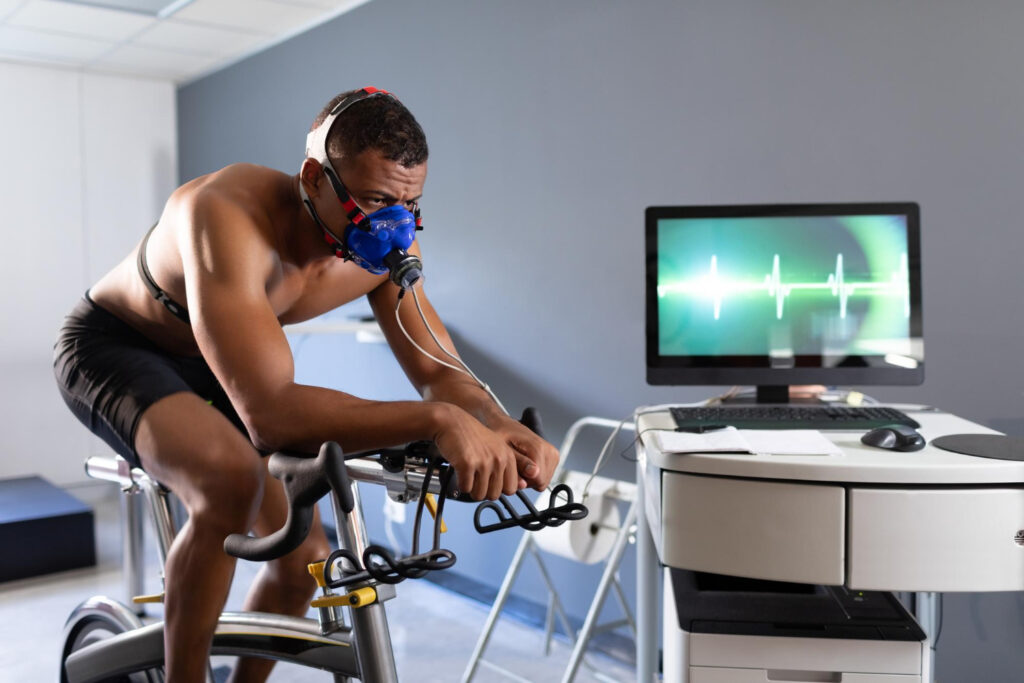
Most calorie targets athletes use every day are estimates. They come from formulas built on age, weight, height, and a general activity multiplier. Those formulas have no idea how much lean muscle you carry, how hard last Tuesday’s ride was, or how your metabolism has shifted over the past two years. For a lot of Highland Park athletes, that gap shows up as stalled results, flat energy late in training, or nutrition plans that stop working the moment the schedule changes.
Resting metabolic rate testing measures what your body actually burns at rest — not what a calculator predicts. That number becomes the foundation for every nutrition and training decision that follows.
What RMR Testing Measures
RMR testing uses indirect calorimetry to measure how much oxygen your body consumes at rest. From that, it calculates your true daily caloric baseline — the number of calories your body needs before any activity is added. It also shows your respiratory quotient, which tells us whether your body is primarily burning carbohydrates or fat at rest.
Generic online calculators estimate this number. RMR testing measures it. For many athletes, the difference between the estimate and the real number is 200 to 400 calories per day. That gap explains a lot.
Common situations where the gap shows up:
- Eating what feels like enough but losing weight unintentionally during high training volume
- Feeling flat or underfueled on long rides or runs despite following a standard nutrition plan
- Body composition not shifting despite consistent training and careful eating
- Recovery feeling harder than it should relative to the actual workload
Once you have a measured baseline, nutrition planning stops being a guessing game.
How RMR Data Works With the Rest of Your Testing
RMR gives you a caloric foundation. DEXA adds the body composition picture — lean mass by segment, fat mass, bone density. Together, they answer two different questions. RMR tells us how much energy your body needs. DEXA tells us what your body is made of and where.
For athletes focused on performance, both numbers matter. A cyclist trying to improve power-to-weight ratio needs to know lean mass distribution as much as they need to know caloric baseline. A masters athlete managing energy levels through a heavy training block needs both to make accurate fueling decisions.
VO2 max testing adds a third layer — aerobic capacity and training zones. It is a separate assessment from RMR and answers different questions about cardiovascular fitness and intensity thresholds.
At our Highland Park studio, these tests are available individually or as part of the complete performance testing package.
What Happens After You Have the Data
Testing without a plan is just numbers on a page. This is where the Perfect Week session comes in.
The Perfect Week is a 30-minute, 1-on-1 consult with Robbie Ventura. It is not a full periodized training plan. It is something more immediately useful — a simple, repeatable seven-day routine built around your actual life.
In that session, Robbie reviews your goals, available training time, activity preferences, and past habits. He then layers in all available testing data — RMR baseline, DEXA body composition, VO2 max zones, and anything else on file — to build a weekly structure that fits. Volume progresses only slightly and only when appropriate. The goal is a routine you can actually repeat, not one you abandon by week three.
The Perfect Week session is $100. It pairs directly with RMR testing, DEXA, and VO2 max results. The more data you bring in, the more precisely Robbie can dial the week to your biology and your schedule.
Who Perfect Week and RMR Testing Are For
Both are for anyone who wants their training time to count. That includes competitive cyclists and triathletes optimizing for race performance, recreational athletes who train consistently but feel like something is off, people returning from injury or a significant life change, and adults focused on long-term health and longevity who want structure without complexity.
You do not need to be chasing a podium. You need to be tired of guessing.
Who This Is Not For
If you are currently managing a metabolic condition, eating disorder, or have been advised by a physician to follow a specific nutrition protocol, please work with your healthcare provider before adding RMR testing to your plan. Vision Quest Coaching is not a medical provider. Testing results are used to inform training and nutrition conversations, not to diagnose or treat.
Frequently Asked Questions
How long does RMR testing take? The test itself takes approximately 15 to 20 minutes. You breathe through a mouthpiece while at rest as the device measures oxygen consumption. You will need to arrive fasted — typically no food for at least four hours beforehand. Your coach will send full prep instructions when you book.
Do I need RMR testing before the Perfect Week session? No. Robbie can build a useful weekly structure from goals, schedule, and habits alone. The more testing data available — RMR, DEXA, VO2 max — the more precisely the week gets dialed in. Testing first gives you the strongest starting point.
How is RMR testing different from the INSCYD metabolic assessment Robbie runs at VQ? RMR testing measures your caloric baseline at rest using indirect calorimetry. The INSCYD assessment is a cycling-specific metabolic evaluation that maps VO2 max, anaerobic power, fat and carbohydrate combustion at every intensity, and lactate dynamics on the bike. They measure different things and serve different purposes. Many athletes benefit from both.
How often should I retest RMR? Every 12 to 16 weeks is a reasonable interval, especially if training volume, body composition, or life circumstances have shifted significantly. Retesting turns a single data point into a trackable trend.
Where is testing available? At our Highland Park studio, 1923 Skokie Valley Rd, Highland Park, IL 60035. Virtual coaching and plan support are available for athletes in Glencoe, Lake Forest, Deerfield, Evanston, and beyond.
Build a Week That Actually Works
RMR testing gives you a number most athletes never have — their real metabolic baseline. The Perfect Week session turns that number into a routine. Together, they replace the guesswork that slows most training down.
To book RMR testing or a Perfect Week session with Robbie, contact us. Our team will walk you through testing options and help you figure out the right starting point.