Move Beyond Generic Calorie Targets
Online calorie calculators can be a handy place to begin, but they are still estimates. They cannot see your body composition, your long ride on Saturday, your stressful workweek, or the way your training goals change from one season to the next.
Late August is a natural time for Highland Park athletes to take a closer look at fueling. Fall marathons, cycling events, triathlons, and offseason strength goals all ask different things of your body. At Vision Quest Coaching, we use testing and individualized coaching to help you build a plan around your real life, available training time, and performance priorities.
Why Calorie Calculators Miss Your Daily Reality
Most calculators use broad formulas based on age, height, weight, sex, and a self-reported activity level. Those details matter, but they do not tell the whole story. A calculator cannot directly account for lean mass, fat mass, sleep, stress, work demands, recovery, or a naturally higher or lower metabolic rate.
That gap often shows up in familiar ways. You may feel flat during long runs, struggle to recover after hard rides, lose weight when you did not mean to, or feel unsure about how much to eat on training days versus rest days. A generic number also cannot keep up when your weekly mileage, strength work, or race schedule changes.
Common details a calculator misses include:
- Changes in training volume from week to week
- Body-composition differences between athletes of the same size
- Recovery needs after hard endurance or strength sessions
- The effect of busy schedules, sleep, and daily activity
For athletes who want a more personal starting point, metabolic rate testing in Highland Park replaces broad assumptions with information we can use in practical nutrition and training conversations.
What RMR Testing Reveals About Your Baseline
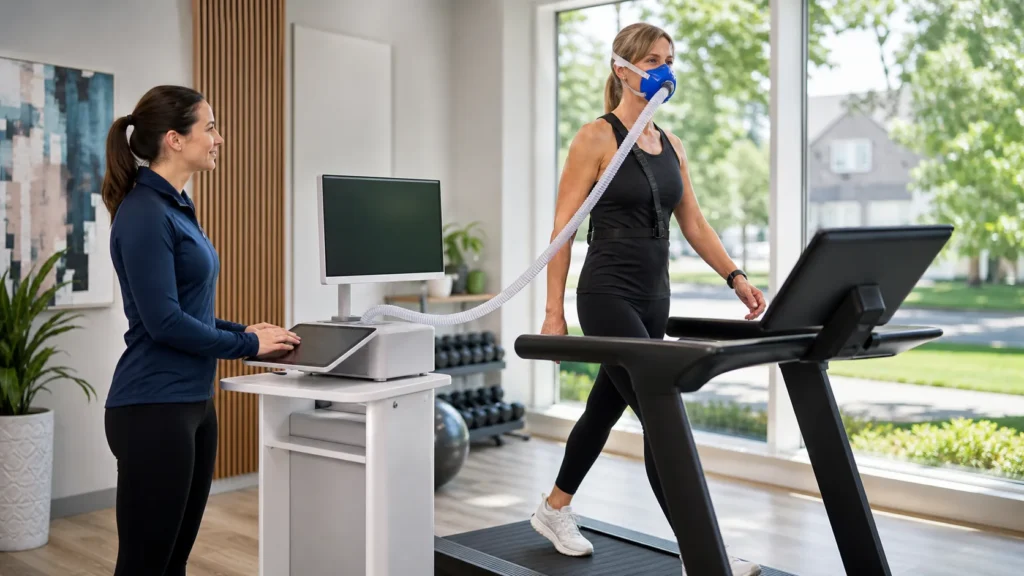
Resting metabolic rate, or RMR, is the energy your body uses at rest to support basic functions. RMR testing measures your individual baseline calorie needs instead of relying only on a population-based equation. That measured baseline gives us a clearer place to begin when discussing your daily intake.
During performance testing in Highland Park, we can pair RMR information with nutrition consultations that reflect the rhythm of your training. Your needs may look different on rest days, strength-training days, high-volume endurance weeks, and race-specific blocks. As your workload, body-composition goals, and performance targets shift, we can revisit those decisions instead of treating one calorie number as permanent.
DEXA scans add another useful layer. DEXA body-composition data shows lean mass and fat mass, while RMR testing establishes a personal metabolic baseline. Together, these assessments give us a stronger foundation for planning nutrition around the work you are actually doing.
Use Performance Testing to Build a Smarter Plan
RMR is one piece of the performance picture, not the entire picture. VO₂ max testing evaluates aerobic capacity and can help you understand endurance fitness, training zones, and performance potential. It answers a different question than a resting metabolic measurement.
We also keep VO₂ max testing separate from the metabolic cycling assessment Robbie conducts at Vision Quest Coaching. VO₂ max testing measures aerobic capacity. The metabolic cycling assessment is a bike-based evaluation that helps us better understand how you respond across cycling intensities. They are related tools, but they are not interchangeable.
When we bring assessments together, your plan can reflect both the data and the calendar. Depending on your goals, we may consider:
- RMR testing and DEXA scans for nutrition planning
- VO₂ max testing for aerobic fitness and training zones
- Strength evaluations in Highland Park for strength-focused goals
- Cycling assessments for bike-specific training insight
Our coaches use these results in individualized triathlon and cycling coaching, then adjust training as fitness, schedule demands, and race priorities evolve. For athletes training from afar, virtual metabolic testing can also support a more informed starting point.
Prepare for Fall Races with Personalized Hydration
As fall marathon season approaches, hydration deserves the same attention as pacing and long-run fueling. Copying another runner’s race-day plan may not match your own sweat rate or sodium needs. What works for a training partner may not fit your body, your effort level, or the conditions on race day.
Sodium and sweat-rate testing can help us build a personalized hydration strategy for long training sessions and competition. The goal is to practice a consistent approach before race day, rather than making last-minute guesses about fluids or sodium.
A hydration plan can help guide:
- Fluid intake during longer sessions
- Sodium replacement based on your personal needs
- Fueling and hydration practice before race day
- Adjustments for changing training demands
Metabolic rate testing in Highland Park complements this work. Hydration, fueling, RMR, body composition, aerobic fitness, and strength all shape how you train and recover. Nutrition consultations help us turn those separate test results into habits that make sense for your training week.
Make Every Training Hour Count
Personal data gives us a clearer way to make decisions than a generic calorie target alone. At our Highland Park studio, we can look at RMR, body composition, aerobic fitness, strength, sweat rate, sodium needs, and cycling-specific performance through separate assessments with distinct purposes.
The most useful plan is not the most complicated one. It is the one that fits your available time, supports your current goal, and can change when your training and life change with it.
Get Clearer Numbers for Your Next Training Block
At Vision Quest Coaching, we use metabolic rate testing in Highland Park to help you understand how your body uses energy at rest and during exercise. Those insights can support more informed nutrition, conditioning, and recovery decisions. If you would like to discuss testing options and your goals, contact us today.