By Robbie Ventura, founder of Vision Quest Coaching and owner of DexaFit Highland Park
The Chicago Marathon fills a weekend every October with roughly 40,000 runners, and a good share of them build their long runs along the North Shore. By race morning, most of them have the fitness they need, but what they do not have is a number. They do not know the pace their engine can hold for three or four hours, the carbohydrate they burn per hour at that effort, or the sodium they lose by mile 18. So they guess. In a marathon, a guess shows up around mile 20, and it is never a pleasant surprise.
This is where marathon performance testing earns its place. I treat a marathon as three separate problems, and each one has a number attached and a test that produces it. Get the three numbers, and you run to a plan. Skip them, and you run to a feeling, which is a fine way to enjoy a race and a poor way to hit a time.
What Is Marathon Performance Testing?
Marathon performance testing is three physiological assessments, a VO2 max test, a DEXA body composition scan, and a sweat and sodium test, that give you the exact pace, fuel, and fluid your body needs to cover 26.2 miles.
The first number is your mass, because you carry it every stride. The second is your engine, the aerobic system that sets your pace and picks your fuel. The third is your chemistry, the fluid and sodium you bleed off over four, five, or six hours. DEXA measures the first. VO2 max measures the second. A sweat test measures the third. Stack the three, and you hold a full race plan instead of a hunch.
DEXA Scan for Runners: Why Body Composition Sets Your Pace Ceiling
Every pound you carry, you carry 26.2 miles, so lower excess mass buys you a faster pace, less impact stress, and quicker recovery.
A DEXA scan does what a bathroom scale cannot. It splits fat mass from lean mass and shows where you carry each, and that split is the point. The target is not lighter at any cost. It is dropping the weight that slows you down while guarding the muscle that moves you forward.
“You are lifting that mass every single time you run. The lower the mass, the faster the speed and the less the stress. So the DEXA can give you a really good idea of how to optimize body composition to increase performance for a marathon.”
The math is concrete. Pace tables tie body weight to race pace and show what a pound, two pounds, or three pounds off does to your split per mile. That turns a vague resolution into a target you can train toward and measure.
Timing decides how useful it is. A DEXA scan helps at any point, because everyone gains from knowing their composition. For a specific race, though, do the work early. Six months out is the ideal window, because peak training is no time to start dieting. A later scan still gives you a baseline, and paired with your VO2 max and sweat numbers, it still sharpens the race plan. You build your body in the base, not the taper.
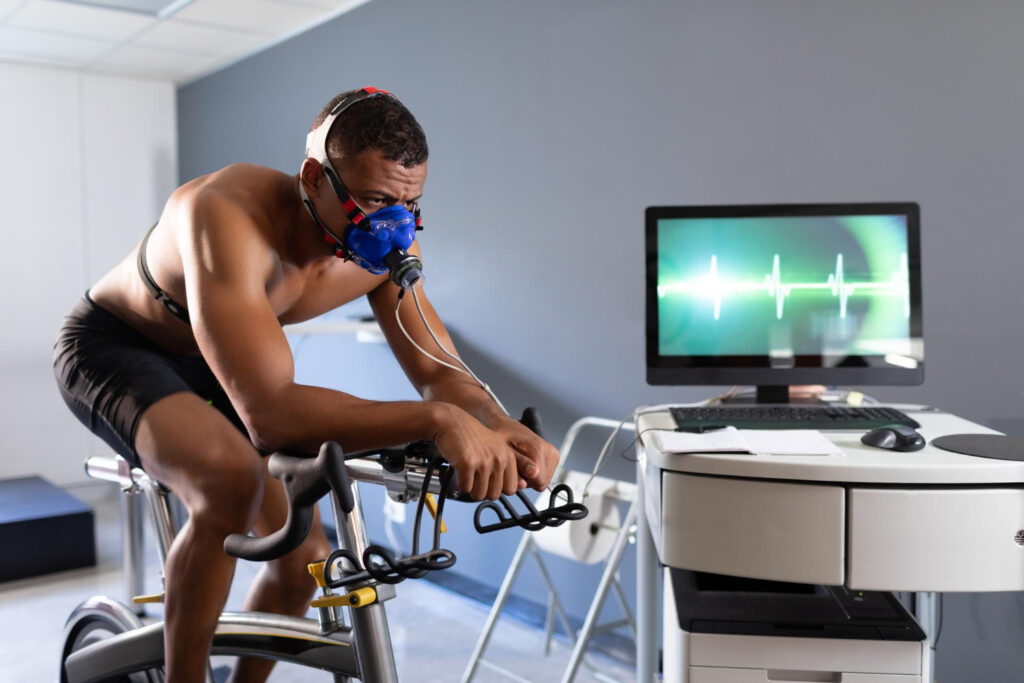
VO2 Max Testing: Your Pacing and Fueling Blueprint
A VO2 max test answers the two questions that decide a marathon, how fast can you hold, and what do you burn to hold it, and it hands you your training zones in the process.
For pacing and fueling, nothing beats it, and it works on three fronts.
It sets your zones. The test pins the heart rate ranges where your aerobic system does its best work, so a base run trains your base and a threshold session trains your threshold, instead of both drifting into a gray middle that improves neither.
It writes your pacing. The effort you can sustain for hours is not the effort that feels right in the
first excited mile. A test tells you the difference before the course does, which is the gap between negative splits and a death march down Michigan Avenue.
It builds your fueling. A VO2 max test finds the point where your body flips from burning fat to burning carbohydrate, and how much carbohydrate you burn per hour at race effort. That
per-hour number is the whole fueling plan. Fuel under it and you hit the wall. Fuel over it and your gut quits. The test replaces both guesses with a figure you rehearse on every long run.
The same test anchors your base. Aerobic fitness is built at zone two, the steady, conversational effort that grows your engine without wrecking you. Most runners only estimate where zone two sits, then train a little too hard and wonder why the base never sticks. Measure it instead. If you are going to spend months at zone two, it is worth knowing exactly where two ends and three begins.
Sweat and Sodium Testing: The Plan That Saves the Back Half
A marathon is a four-to-six-hour sweat loss you did not plan for, so a sweat test converts your personal fluid and sodium losses into an hourly drinking plan.
A sweat test reads your sweat rate and the sodium concentration in that sweat, then turns both into a per-hour target. Two runners on the same start line can lose wildly different amounts, and the only way to know yours is to measure it. Copying the person next to you is how cramps and bonks happen at the same mile every year.
This is also why the marathon, not the 5K, is the event that earns this test. You do not need a sodium plan unless you are out there past two hours. A 5K never reaches your hydration ceiling. A marathoner runs against it through the entire back half. So does an Ironman athlete, which is why the same three-test profile carries straight into triathlon prep, only with a longer runway and a tighter taper.
Marathon Testing Timeline: When to Book Each Test
Ideally, test about six months out so you can train smarter off the results, then retest before the race to adjust to your new fitness. Even a month out, the information still helps you set a better race plan.
Six months out, in your base phase, is the ideal window for the DEXA scan and your first VO2 max test. That is where body composition work belongs and where you set the training zones that shape the whole block. Through the build, recheck VO2 max if your fitness has jumped, and lock the fueling grams you will practice in every long run. In the last few weeks, run the sweat and sodium test so your hydration plan is dialed before you taper. And if your race is already close, do not skip it. Even a month out, your VO2 max, fueling, and hydration numbers sharpen your pacing and race-day plan. Earlier gives you more time to act on the results. Later still beats guessing.
How Race-Day Heat Changes Your Goal Marathon Pace
Heat raises the physiological cost of every mile, so your tested numbers are only half the plan until you pair them with the forecast.
One variable sits outside your body and inside every result: temperature.
Pace-versus-temperature tables show exactly how much to ease off as the mercury climbs, and October in Chicago can hand you anything from a crisp start in the forties to a warm slog in the seventies. The runner who adjusts the plan to the forecast passes the runner who clings to a goal pace the weather already erased.
Book VO2 Max, DEXA, and Sweat Testing at DexaFit Highland Park
Training earns your fitness. Testing tells you what to do with it. With the Chicago Marathon in October, the base-phase tests need to happen now. Book your VO2 max test, DEXA scan, and sweat test at DexaFit Highland Park and line up in October with three numbers and a plan instead of a hope. Reserve your marathon testing bundle here.
Marathon Testing Questions Chicago Runners Ask
How far in advance should I get a VO2 max test and DEXA scan before a marathon?
Book your DEXA scan and first VO2 max test about six months out, in your base phase, when body composition work and training zones pay off most. Save the sweat and sodium test for the final few weeks, when you lock in your hydration plan without adding training load.
Is a VO2 max test worth it if my marathon is only a few weeks away?
Yes. Even weeks out, a VO2 max test confirms the heart rate you should hold and the carbohydrate you need to take in per hour to finish strong. It pays off most early in the cycle, but it is never wasted.
What does a DEXA scan tell a runner that a bathroom scale cannot?
A scale gives you one number. A DEXA scan splits fat from lean mass and shows where each sits, so you can drop the weight that slows you down while protecting the muscle that drives your stride.
Do I need a sweat test to run the Chicago Marathon?
For any effort past two hours, yes. A marathon runs your hydration and sodium system to its edge. A sweat test measures your sweat rate and sodium loss and turns them into an hourly fluid and sodium target so you do not cramp or bonk in the back half.
Will VO2 max and DEXA testing help me run a faster marathon?
Testing does not add fitness, but it converts the fitness you build into a faster time. A VO2 max test sets the exact pace and fueling that prevent a blowup, and a DEXA scan lowers the weight you carry over 26.2 miles. Together they remove the two most common reasons a trained runner misses a goal, going out too fast and carrying too much.
Where can I get marathon performance testing near Chicago’s North Shore?
DexaFit Highland Park offers VO2 max testing, DEXA body composition scans, and sweat and sodium testing for runners across Chicago’s North Shore, with coaching support from Vision Quest Coaching founder Robbie Ventura.